UAE New WPS Rules (2026): Employer Obligations, Salary Payment Rules & Compliance Guide
The UAE Wage Protection System (WPS) is one of the country’s most important labour initiatives, ensuring employees receive their salaries accurately and on time. Introduced by the Ministry of Human Resources and Emiratisation (MOHRE) in partnership with the Central Bank of the UAE, the WPS creates a secure electronic salary transfer system that protects both employers and employees.
In recent years, the UAE has strengthened its labour regulations to improve transparency, protect workers’ rights, and encourage responsible business practices. As a result, employers operating in the private sector must understand the latest WPS requirements, salary payment deadlines, and compliance obligations to avoid fines and operational restrictions.
Whether you own a small business, manage a growing company, or work in human resources, understanding the UAE new WPS rules is essential for maintaining legal compliance and ensuring employees are paid correctly every month.
Disclaimer: This guide is provided for general informational purposes only and should not be considered legal advice. Labour laws and Wage Protection System (WPS) requirements may change over time. Employers and employees should always verify the latest regulations through the official Ministry of Human Resources and Emiratisation (MOHRE) – Wages Protection System before making employment or payroll decisions.
What Is the UAE Wage Protection System (WPS)?
The Wage Protection System (WPS) is an electronic salary transfer system introduced by the UAE Government to ensure employees receive their wages according to the terms stated in their employment contracts.
Instead of paying salaries manually or in cash, employers submit salary information electronically through approved WPS agents such as banks, exchange houses, and financial institutions.
The system allows MOHRE to monitor salary payments and identify employers who fail to pay wages on time.
Main Objectives of WPS
- Ensure salaries are paid on time.
- Protect employee rights.
- Improve transparency in payroll processing.
- Reduce labour disputes.
- Support compliance with UAE Labour Law.
- Strengthen confidence in the UAE employment market.
Today, WPS is a key component of labour compliance for many private-sector employers across the UAE.
UAE Wage Protection System Updates
The UAE continues to modernize the Wage Protection System (WPS) to strengthen employee wage protection and improve payroll compliance across the private sector. In addition to expanding digital salary payment channels, the Ministry of Human Resources and Emiratisation (MOHRE) has introduced updated WPS regulations that took effect from 1 June 2026, making salary payment requirements more standardized and transparent.
The updated system enables employers to process salaries through an expanded network of approved digital platforms and financial institutions accredited by MOHRE. It also enhances electronic monitoring of payroll submissions, improves verification processes, and supports faster salary transfers while reducing administrative procedures. These improvements aim to protect employee rights, minimize payroll disputes, and encourage greater compliance among private-sector employers.
As labour regulations continue to evolve, employers should regularly review official MOHRE announcements and ensure their payroll systems, Salary Information Files (SIF), and salary payment schedules comply with the latest WPS requirements.
What’s New in the UAE WPS Rules?
From 1 June 2026, the UAE introduced important changes to the Wage Protection System to strengthen salary compliance in the private sector. Under the updated rules, employers registered with MOHRE must pay employee wages before the beginning of the following month through the Wage Protection System or another payment channel approved by the Ministry. Employers are also required to maintain accurate payroll records and provide supporting salary payment information when requested.
The latest WPS rules also introduce clearer compliance standards and faster enforcement for delayed salary payments. Employers are generally considered compliant when at least 85% of total wages are paid on time, and employees receive at least 85% of their entitled salary, provided any remaining difference is due to documented and lawful deductions. The updated framework also accelerates administrative action against repeated non-compliance, highlighting the importance of timely payroll processing and accurate Salary Information Files (SIF).
These updates reinforce the UAE’s commitment to protecting employee wages while helping employers adopt more efficient, transparent, and digitally enabled payroll practices. Businesses should review their payroll procedures regularly to remain compliant with the latest MOHRE requirements.
Why Is WPS Important?
The Wage Protection System benefits both employers and employees.
For employees, it provides confidence that salaries are transferred through secure, traceable channels and helps reduce disputes over unpaid wages.
For employers, WPS demonstrates compliance with UAE labour regulations, improves payroll accuracy, and supports a transparent employment relationship.
Benefits for Employees
- Timely salary payments.
- Greater wage protection.
- Reduced payroll disputes.
- Transparent salary records.
- Improved financial security.
Benefits for Employers
- Compliance with labour regulations.
- Improved payroll management.
- Better employee trust.
- Reduced legal risks.
- Stronger corporate reputation.
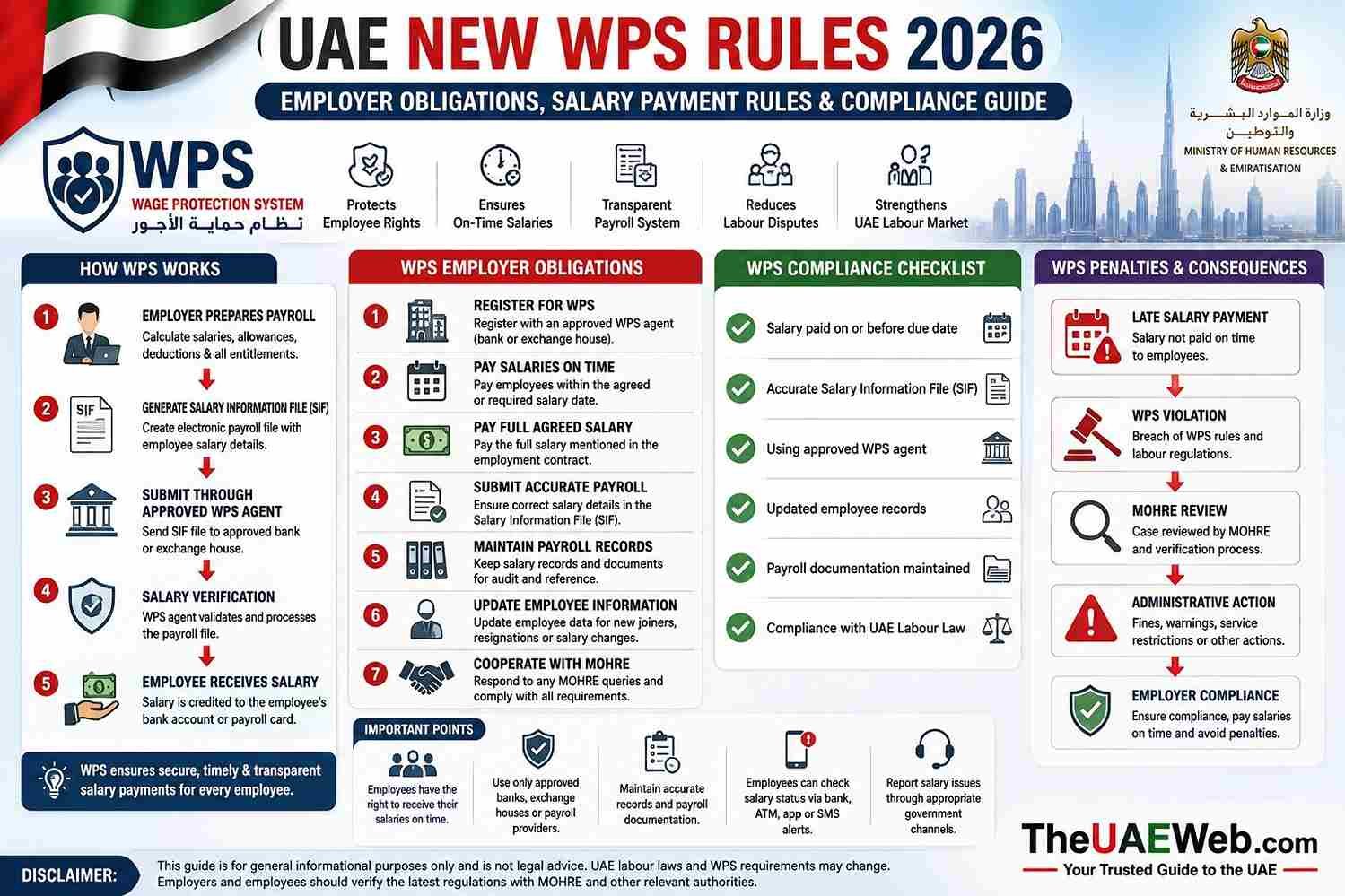
WPS Employer Obligations in the UAE
Employers registered under the Wage Protection System have several important responsibilities.
Understanding these obligations helps businesses remain compliant while avoiding penalties and administrative restrictions.
1. Register for the Wage Protection System
Employers must register with the WPS through approved financial institutions or authorized payroll service providers.
Only approved WPS channels should be used for salary processing.
2. Pay Employees on Time
One of the most important employer obligations is paying salaries within the timeframe required under UAE labour regulations and employment contracts.
Late salary payments may trigger compliance actions and administrative measures.
3. Pay the Full Agreed Salary
Employees must receive the salary specified in their employment contract unless lawful deductions apply under UAE Labour Law.
Unauthorized deductions may result in employee complaints and regulatory action.
4. Submit Accurate Payroll Information
Employers are responsible for ensuring salary records are complete and accurate before submitting payroll through the Wage Protection System.
Incorrect employee information can delay salary processing.
5. Maintain Payroll Records
Businesses should maintain payroll documentation and salary payment records for future reference, audits, or dispute resolution.
Accurate record keeping supports compliance and improves payroll transparency.
6. Update Employee Information
Whenever employees join, resign, change salary, or update employment details, payroll records should also be updated to ensure accurate WPS submissions.
7. Cooperate with MOHRE Requirements
Employers should respond promptly to any requests from MOHRE regarding payroll information, employment records, or salary payment verification.
Maintaining cooperation helps resolve issues quickly and demonstrates good compliance practices.
Salary Payment Deadlines Under WPS
One of the primary goals of the Wage Protection System is ensuring employees receive their salaries without unnecessary delays.
Employers should process salaries according to the agreed employment contract and applicable labour regulations.
Paying salaries consistently and on schedule helps businesses maintain compliance while improving employee satisfaction and trust.
Delayed salary payments may result in investigations, administrative restrictions, or other enforcement actions depending on the circumstances.
How Employers Register for WPS
Businesses required to use the Wage Protection System generally follow these steps:
- Register the company with MOHRE, where applicable.
- Choose an approved WPS agent such as a participating bank or exchange house.
- Prepare employee payroll information.
- Generate the required Salary Information File (SIF).
- Submit payroll through the approved WPS channel.
- Confirm successful salary processing.
- Maintain payroll records for future reference.
Many payroll software providers also integrate directly with WPS requirements, making monthly salary processing more efficient.
Who Must Comply with WPS?
In general, many private-sector employers regulated by MOHRE are required to comply with the Wage Protection System.
The exact requirements depend on factors such as:
- Company registration
- Business activity
- Employment category
- Applicable labour regulations
- Government directives
Businesses should verify their obligations directly with MOHRE or seek professional advice if they are unsure about their compliance requirements.
Common WPS Compliance Mistakes
Many payroll issues occur because employers overlook simple administrative requirements.
Some of the most common mistakes include:
- Paying salaries after the due date.
- Incorrect employee bank details.
- Errors in payroll calculations.
- Incomplete Salary Information Files (SIF).
- Failure to update employee records.
- Missing payroll documentation.
- Using unauthorized salary payment methods.
Implementing a structured payroll process can help reduce these risks and improve overall compliance.
Approved WPS Agents in the UAE
The Wage Protection System operates through approved financial institutions authorized to process salary payments. These organizations act as intermediaries between employers and employees, ensuring salaries are transferred securely and electronically.
Approved WPS agents generally include:
- UAE banks
- Exchange houses
- Financial institutions approved by the Central Bank of the UAE
- Licensed payroll service providers
Employers should always choose an approved WPS agent to ensure salary files are processed correctly and in compliance with UAE regulations.
What Is the Salary Information File (SIF)?
The Salary Information File (SIF) is one of the most important components of the Wage Protection System.
It is an electronic payroll file prepared by the employer that contains salary details for every employee. The file is submitted through an approved WPS agent, which then processes salary payments.
A typical SIF includes information such as:
- Employer details
- Employee name
- Labour or employee identification details
- Salary amount
- Basic salary
- Allowances
- Salary payment period
- Payment date
- Bank or payroll account information
Submitting an accurate Salary Information File helps ensure salaries are processed smoothly without delays or errors.
How the WPS Salary Process Works
Understanding the payroll process helps employers avoid mistakes and improve efficiency.
Step 1: Prepare Monthly Payroll
The employer calculates salaries according to employment contracts, attendance records, overtime, commissions, and approved deductions.
Step 2: Generate the Salary Information File
Payroll software or payroll administrators prepare the Salary Information File containing all employee salary details.
Step 3: Submit Through an Approved WPS Agent
The SIF is sent to an authorized bank or exchange house participating in the Wage Protection System.
Step 4: Salary Verification
The payroll data is validated before salaries are transferred to employees.
Step 5: Employees Receive Their Salaries
Once approved, salaries are deposited into employee bank accounts or payroll cards through approved WPS channels.
This electronic process creates a secure record of salary payments for both employers and employees.
Employee Rights Under the Wage Protection System
The WPS was introduced primarily to protect employees and ensure fair salary practices across the UAE.
Employees covered by the system generally benefit from:
- Timely salary payments
- Accurate salary records
- Greater payroll transparency
- Protection against delayed wage payments
- Electronic salary payment records
- Improved dispute resolution
If salary issues arise, employees may be able to raise concerns through the appropriate government channels, subject to applicable labour laws and procedures.
WPS Compliance Best Practices for Employers
Maintaining compliance is easier when businesses establish a consistent payroll process.
Recommended best practices include:
Process Salaries on Time
Avoid waiting until the last day to process payroll. Early preparation reduces the risk of delays.
Review Payroll Before Submission
Double-check salary calculations, employee details, and allowances before generating the Salary Information File.
Keep Employee Records Updated
Update payroll information whenever an employee joins, resigns, changes salary, or updates banking details.
Maintain Payroll Documentation
Keep copies of payroll reports, salary records, and payment confirmations for future reference.
Work With Reliable Payroll Providers
Using experienced payroll software or professional payroll service providers can significantly reduce errors.
WPS Rules for Small Businesses
Small businesses operating in the UAE should not assume that payroll compliance requirements are less important.
Business owners should:
- Register with the appropriate authorities.
- Understand whether WPS applies to their company.
- Use approved salary payment channels.
- Process salaries on time.
- Keep accurate payroll records.
Even companies with a small workforce benefit from maintaining transparent payroll practices.
WPS in Free Zones
Free zone companies may be subject to different employment regulations depending on the free zone authority governing their operations.
Some free zones operate payroll systems aligned with WPS principles, while others have separate employment frameworks.
Because requirements vary, employers should always confirm payroll obligations with their specific free zone authority.
Examples include:
- Dubai Multi Commodities Centre (DMCC)
- Dubai International Financial Centre (DIFC)
- Abu Dhabi Global Market (ADGM)
- Jebel Ali Free Zone (JAFZA)
- Dubai Silicon Oasis (DSO)
Each authority may have its own employment and payroll requirements.
Domestic Worker Salary Rules
Domestic workers are governed under a separate legal framework from many private-sector employees.
Salary payment methods, employment contracts, and employer responsibilities may differ from standard WPS procedures.
Employers hiring domestic workers should always follow the regulations applicable to domestic worker employment and verify current requirements through the relevant government authorities.
What Happens If Salaries Are Delayed?
Late salary payments can affect both employees and employers.
For employees, delayed wages may create financial difficulties, including challenges in paying rent, transportation, education fees, or other essential expenses.
For employers, repeated delays may result in increased scrutiny from the relevant authorities and potential administrative consequences under applicable labour regulations.
Businesses should establish reliable payroll schedules to minimize the risk of delays.
How Employees Can Check Salary Status
Employees can usually confirm whether their salary has been processed through several methods, depending on how they receive their wages.
Common options include:
- Checking their bank account.
- Reviewing payroll card balances.
- Using the mobile app provided by their payroll card issuer.
- Visiting an ATM.
- Contacting their bank or exchange house.
- Reviewing SMS salary notifications, where available.
Employees who believe their salary has not been paid should first contact their employer or HR department before escalating the matter through the appropriate official channels.
Common Employer Questions
Can employers pay salaries in cash?
Where WPS applies, salaries generally need to be processed through approved electronic channels rather than informal payment methods.
Can payroll mistakes be corrected?
Yes. Employers should work with their payroll provider or WPS agent to correct errors as quickly as possible.
What if an employee changes banks?
Payroll records should be updated before the next salary cycle to avoid payment failures.
Can payroll software help with WPS?
Yes. Many payroll systems generate Salary Information Files and simplify monthly payroll processing while reducing manual errors.
How often should payroll records be reviewed?
Employers should review payroll information every salary cycle to ensure continued compliance and data accuracy.
WPS Penalties for Employers in the UAE
The UAE takes salary protection seriously. Employers who fail to comply with the Wage Protection System (WPS) may face administrative actions depending on the nature, duration, and severity of the violation.
Possible consequences of non-compliance include:
- Administrative penalties
- Suspension or restriction of certain MOHRE services
- Increased regulatory monitoring
- Delays in processing new work permits
- Labour inspections
- Legal action in serious cases
The exact action depends on the applicable UAE labour laws and the employer’s compliance history.
Common WPS Violations
Businesses should avoid practices that may result in WPS non-compliance.
Some common violations include:
- Delaying employee salary payments.
- Paying salaries outside approved WPS channels where WPS applies.
- Submitting incorrect payroll information.
- Paying less than the agreed contractual salary without lawful justification.
- Failing to update employee payroll records.
- Repeated payroll submission errors.
- Providing inaccurate Salary Information Files (SIF).
Maintaining an organized payroll process helps reduce these risks and ensures smoother salary processing.
How to Stay WPS Compliant
Employers can improve compliance by following a few best practices:
- Process salaries on or before the agreed payment date.
- Use only approved WPS banks or exchange houses.
- Verify employee information before each payroll cycle.
- Generate accurate Salary Information Files.
- Keep payroll records organized.
- Monitor payroll submissions for errors.
- Stay informed about updates issued by MOHRE.
- Train HR and payroll staff on WPS procedures.
- Conduct periodic payroll audits.
A proactive approach to payroll management reduces compliance risks and builds employee trust.
Why WPS Benefits Employers
Although WPS is designed to protect employees, employers also benefit from the system.
Key advantages include:
- More transparent payroll processing.
- Better payroll documentation.
- Fewer salary disputes.
- Improved employee satisfaction.
- Easier compliance with labour regulations.
- Stronger business reputation.
- Streamlined payroll administration.
- Enhanced confidence among employees and stakeholders.
Businesses that consistently comply with WPS requirements are better positioned to maintain smooth operations and positive workplace relationships.
Frequently Asked Questions
What is the Wage Protection System (WPS)?
The Wage Protection System (WPS) is an electronic salary transfer system that helps ensure employees receive their wages accurately and on time through approved financial institutions.
Who must comply with WPS in the UAE?
Many private-sector employers regulated by the Ministry of Human Resources and Emiratisation (MOHRE) are required to comply with WPS. Specific requirements depend on the company’s legal status, business activity, and applicable regulations.
What are the employer obligations under WPS?
Employers are generally responsible for paying salaries on time, submitting accurate payroll information, maintaining employee records, using approved WPS channels, and complying with applicable labour regulations.
What is a Salary Information File (SIF)?
A Salary Information File (SIF) is an electronic payroll file containing employee salary details that employers submit through an approved WPS agent to process salary payments.
Can employees check if their salary has been paid?
Yes. Employees can usually verify salary payments through their bank account, payroll card, mobile banking app, ATM, SMS notification, or by contacting their payroll provider.
What happens if salaries are paid late?
Delayed salary payments may lead to administrative actions, increased regulatory oversight, and restrictions depending on the applicable UAE labour regulations and the circumstances of the delay.
Do free zone companies follow WPS?
Requirements differ between free zones. Employers should always check with their specific free zone authority to confirm applicable payroll and employment regulations.
Is WPS mandatory for every company?
WPS requirements vary depending on company registration, business activity, and the authority regulating the employer. Businesses should verify their obligations directly with MOHRE or the relevant authority.
Safety & Compliance Note
Always process employee salaries through approved WPS banks, exchange houses, or licensed payroll providers where applicable. Employers should never use unofficial salary payment methods if WPS requirements apply. Employees should verify salary payments through official banking channels and report payroll concerns through the appropriate government authorities when necessary.
Conclusion
The UAE Wage Protection System plays a vital role in creating a transparent and reliable employment environment by ensuring salaries are paid accurately and on time. Understanding the new UAE WPS rules, employer obligations, payroll procedures, and compliance requirements helps businesses avoid unnecessary issues while protecting employee rights.
Whether you are a business owner, HR professional, payroll administrator, or employee, staying informed about WPS requirements is essential for maintaining compliance with UAE labour regulations. Regularly reviewing payroll processes, keeping employee records updated, and following official guidance from MOHRE can help ensure smooth salary management.
For more practical guides on UAE labour laws, employment regulations, business compliance, banking, and government services, visit TheUAEWeb.com, where we publish accurate, easy-to-understand resources designed to help residents, employees, and employers navigate life and work in the UAE.