Digital Currency System Case Studies: How Real Projects Like Hamilton, Cedar and the Digital Dirham Work
Type “Project Hamilton” into Google and you get a Federal Reserve experiment, a rumour about a scandal, and a chart of what college majors earn. They’re two unrelated projects with similar names, and the pages that rank rarely tell you which is which.
Here’s the short answer. Real digital currency systems are mostly central bank digital currencies (CBDCs), and the best-documented case studies are research projects. Project Hamilton built an open-source payment engine but never aimed to launch a US coin. Project Cedar tested wholesale settlement. The UAE’s Digital Dirham is the one closest to real use, with a government transaction completed in November 2025.
This guide covers each case, what it proved, where it fell short, and how the UAE fits in.
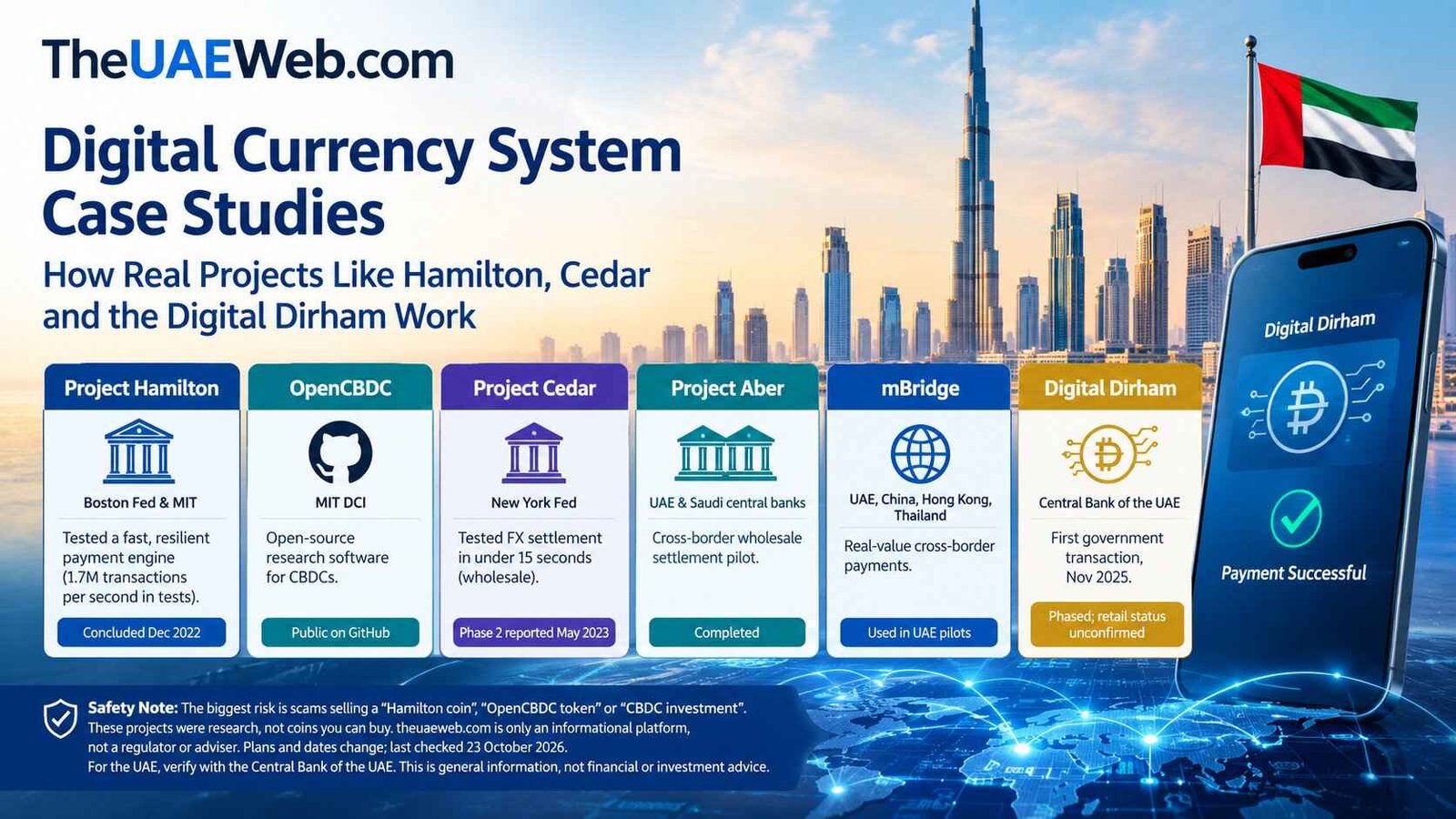
Safety Note: The biggest risk is scams selling a “Hamilton coin”, “OpenCBDC token” or “CBDC investment”. These projects were research, not coins you can buy. theuaeweb.com is only an informational platform, not a regulator or adviser. Plans and dates change; last checked 23 October 2026. For the UAE, verify with the Central Bank of the UAE, for example its Digital Dirham report. This is general information, not financial or investment advice.
What is a digital currency system, and what counts as a real project?
A digital currency system is a way of issuing and moving money in digital form. In this article it means a central bank digital currency (CBDC): digital money issued by a central bank, unlike bitcoin or a private stablecoin. Retail CBDCs are for the public. Wholesale CBDCs are for banks and institutions settling large payments.
| Term | Who issues it | Who uses it |
|---|---|---|
| Retail CBDC | Central bank | Public and businesses |
| Wholesale CBDC | Central bank | Banks and financial institutions |
| Stablecoin | Private issuer | Anyone, under licence rules |
| Crypto (e.g. bitcoin) | No issuer | Anyone |
“Real project” here means a documented experiment or pilot with published results, not a white paper idea.
Quick comparison of the case studies
| Project | Who | Type | What it showed | Status |
|---|---|---|---|---|
| Project Hamilton | Boston Fed and MIT DCI | Retail research | A fast, resilient transaction engine (about 1.7 million transactions per second in tests) | Concluded Dec 2022 |
| OpenCBDC | MIT DCI and contributors | Open-source code | Reusable research software | Public on GitHub |
| Project Cedar | New York Fed Innovation Center | Wholesale prototype | FX settlement in under 15 seconds in a test | Phase 2 reported May 2023 |
| Project Aber | UAE and Saudi central banks | Cross-border wholesale | Joint settlement pilot, 2019–2020 | Completed |
| mBridge | UAE, China, Hong Kong, Thailand | Cross-border | Real-value cross-border payments | Used in UAE pilots |
| Digital Dirham | CBUAE | Retail and wholesale | First government transaction, Nov 2025 | Phased; retail status unconfirmed |
What is Project Hamilton CBDC?
Project Hamilton was a research project to test the technology behind a hypothetical US digital dollar. The Boston Fed and MIT’s Digital Currency Initiative announced it in 2020 as a multi-year collaboration. It focused on technological experimentation and did not aim to create a usable CBDC for the United States.
The Phase 1 whitepaper came out on 3 February 2022, with the code released under the MIT open-source licence. The work was separate from the Federal Reserve Board’s own evaluation of CBDC policy.
What did Project Hamilton actually prove?
It showed that a central bank payment engine could be very fast and survive outages. The research described a successful test of an architecture handling 1.7 million transactions per second. The team explored two architectures, both based on an unspent transaction output (UTXO) model. It rejected blockchain for a retail digital dollar because of speed challenges.
It also showed what wasn’t solved. Privacy and interoperability were left for phase two. A 2024 academic review noted that the team did not incorporate stronger privacy features, such as designs by the cryptographer David Chaum, into its architecture. A fast engine and a private one are different goals.
Is there a Project Hamilton scandal?
No wrongdoing has been shown in anything I found. “Scandal” is a search-term framing of what was a political controversy.
In December 2022, nine members of the US House, led by Representative Emmer of Minnesota, wrote to the Boston Fed’s president questioning the role of private-sector firms in the project and its privacy implications. Coverage said the letter suggested other companies involved could gain an unfair advantage in the CBDC space. Three weeks later, the Boston Fed announced the project’s conclusion.
Retail Central Bank Digital Currency: Motivations, Opportunities, and Mistakes
The Boston Fed’s Jim Cunha described the project as “agnostic” about future US policy and focused on the capabilities and limits of different technologies. The order of events is documented. A cause-and-effect link between the letter and the end of the project is not, so don’t present one as fact.
What is OpenCBDC, and what’s on the MIT DCI GitHub?
OpenCBDC is open-source research software for central bank digital currencies, and it’s the code that came out of Project Hamilton. The MIT DCI GitHub repository, mit-dci/opencbdc-tx, contains the core transaction processor for a hypothetical, general-purpose CBDC, initially derived from Project Hamilton.
- Licence: The code is under the MIT licence, and contributions are redistributed under the same licence.
- Maintainer: OpenCBDC itself operates in the open and is maintained by the DCI.
- Architectures: The two designs use an unspent hash set (UHS) abstraction. One, the “atomizer”, provides linearizability, while the other provides only serializability.
It’s a research tool. It isn’t a currency, a token or an investment. Check the repository yourself for current activity, since I couldn’t confirm recent commits.
What is Project Cedar?
Project Cedar is the New York Fed Innovation Center’s wholesale CBDC project, aimed at cross-border payments between institutions. It was the first project of the New York Innovation Center, launched in November 2021 in collaboration with the BIS Innovation Hub. blockworks
Phase 1 was a 12-week experiment. It found that a distributed-ledger prototype could settle foreign exchange transactions in under 15 seconds on average, compared with up to two days for most FX spot trades. Phase II partnered with the Monetary Authority of Singapore’s Ubin+ project to test multi-currency, cross-border settlement. Findings from Phases 1 and 2 were released in November 2022 and May 2023.
Digital currency can settle forex transactions in 15 seconds: Study
How do Hamilton and Cedar differ?
| Project Hamilton | Project Cedar | |
|---|---|---|
| Question | Can one engine serve a whole country’s retail payments? | Can wholesale CBDC speed up cross-border FX? |
| Users | Public | Banks and institutions |
| Main result | About 1.7 million TPS in tests | FX settlement in under 15 seconds in a test |
| Partner | MIT DCI | BIS Innovation Hub, MAS |
| Output | Open-source code | Reports and prototype |
What have UAE case studies shown?
The UAE has run real-value pilots, not just research. It tested wholesale CBDC settlement with Saudi Arabia in Project Aber from 2019 to 2020, then became a founding participant in mBridge with Hong Kong, China and Thailand.
In January 2024, the CBUAE issued the first Digital Dirham as legal tender on its issuance platform and used it to start a cross-border payment on the mBridge MVP. On 11 November 2025, the Ministry of Finance and Dubai Finance announced the UAE’s first government transaction using the Digital Dirham, run as a pilot through mBridge. Settlement took under two minutes.
The CBUAE chose R3 for the infrastructure and G42 Cloud for the technology. At launch, the Digital Dirham is meant to be non-interest bearing.
Is the Digital Dirham live for the public?
That isn’t confirmed, and sources conflict. One explainer says the retail rollout slipped past the original Q4 2025 target, with broader availability expected in phases through 2026. Another, dated 8 October 2026, says the first retail phase went live in December 2025 through licensed providers. A third, from August 2026, says no retail launch has been confirmed by a central bank statement.
What’s confirmed is the pilot: the first government transaction in November 2025 and the January 2024 cross-border payment. For retail availability, check the CBUAE and your own bank. Be cautious with any article stating an exact launch date.
Why does “Hamilton Project career earnings by major” show up in these searches?
Because it’s a different Hamilton. The Hamilton Project is an economic policy initiative at the Brookings Institution. It has no link to the Boston Fed project.
Its tool compares earnings by degree. The October 2020 interactive uses US Census data to compare earnings for 80 majors and found a typical college graduate earns $1.19 million over a working life, compared with $580,000 for a typical high school graduate. A separate tool covers 171 majors and career paths.
These are US figures in US dollars. They don’t predict UAE salaries.
What do these case studies teach?
- Speed isn’t the hard part. Hamilton and Cedar both hit impressive speeds. Privacy, interoperability and politics took more work.
- Research and launch are different jobs. Hamilton never aimed to launch. The UAE did, and its retail timeline has moved.
- Wholesale is moving faster than retail. Cedar, Aber and mBridge target banks and governments first.
- Open code lets others check the work. OpenCBDC’s licence means anyone can inspect the design.
- Dates slip. Treat promised launch windows as plans.
Myths vs facts
| Myth | Fact |
|---|---|
| Project Hamilton was a US digital dollar launch | It was research and didn’t aim to produce a usable CBDC |
| There was a Hamilton scandal | A congressional letter and project conclusion are documented; wrongdoing isn’t |
| OpenCBDC is a cryptocurrency | It’s open-source research software |
| The Hamilton Project is the Fed project | It’s a Brookings policy initiative |
| Project Cedar is a coin | It was a wholesale prototype experiment |
| The Digital Dirham retail date is settled | Sources conflict; verify with the CBUAE |
Who should not rely on this article?
- Anyone deciding where to invest money
- Anyone responding to an offer to buy a “CBDC token”
- Developers needing the latest code details, who should read the repository
- Businesses needing exact Digital Dirham dates, who should ask their bank or the CBUAE
What if you’re offered a “CBDC coin”?
Walk away. None of these projects issues a tradable coin. For crypto and digital asset products in the UAE, check that the provider is licensed with the relevant regulator, and verify through official channels, not the seller’s own site.
People Also Ask: Digital currency case studies FAQ
What is Project Hamilton CBDC?
A Boston Fed and MIT DCI research project testing the technology for a hypothetical US digital dollar. It didn’t aim to create a usable CBDC.
What did Project Hamilton find?
A test architecture handled about 1.7 million transactions per second. Privacy and interoperability were left for later work.
Was there a Hamilton Project scandal?
No wrongdoing was shown in the sources I found. Lawmakers questioned private-sector involvement and privacy in December 2022, and the project concluded weeks later.
What is OpenCBDC?
Open-source research software for CBDCs, derived from Project Hamilton and maintained by the MIT DCI under the MIT licence.
What is on the MIT DCI GitHub?
The mit-dci/opencbdc-tx repository, a transaction processor for a hypothetical CBDC.
What is Project Cedar?
The New York Fed Innovation Center’s wholesale CBDC project. Its first phase settled FX transactions in under 15 seconds in a test.
What is the UAE’s digital currency project?
The Digital Dirham, run by the Central Bank of the UAE. The first government transaction was announced in November 2025.
Is the Digital Dirham available to the public?
Sources conflict. Check the CBUAE and your bank.
Is The Hamilton Project the same as Project Hamilton?
No. The Hamilton Project is a Brookings policy initiative known for its career earnings by college major tool.