UAE Jobs Job-Hugging Trend 2026
If you have been watching the UAE jobs market in 2026, you may have noticed a change in the way people talk about changing jobs. A few years ago, moving to a new company for a better salary or title could feel like the obvious career move. Today, many employees are taking a more careful approach.
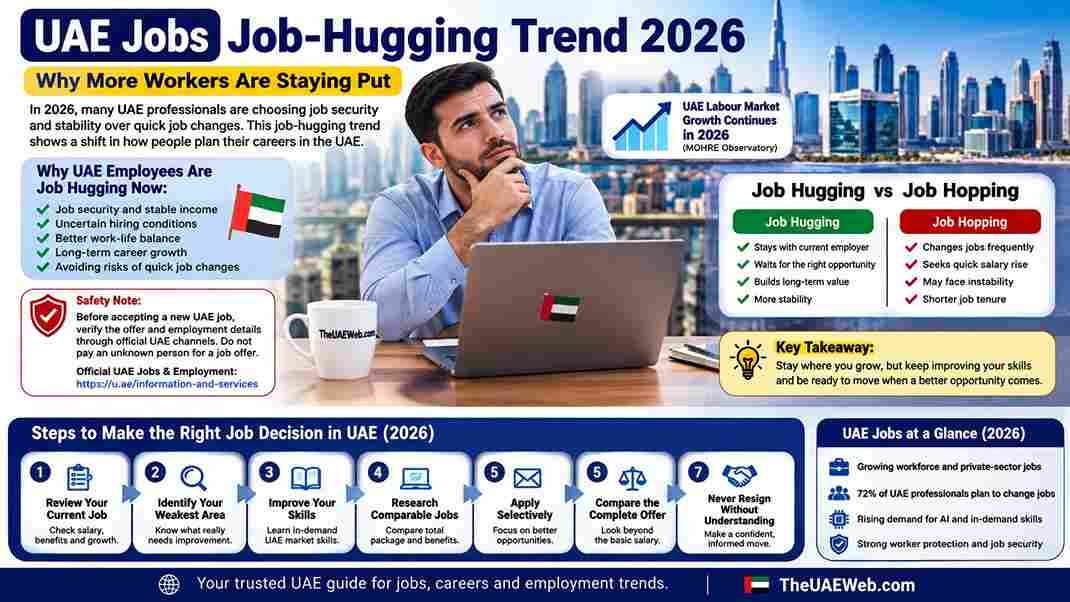
This is where the job-hugging trend comes in. Instead of actively chasing every new opportunity, some UAE workers are choosing to hold on to their current jobs while they wait for a clearer and safer opportunity.
That does not mean people have stopped looking for better jobs. It means they are becoming more selective about when they move.
The trend is particularly interesting because the UAE labour market itself continues to expand. The UAE Labour Market Observatory reported growth in workforce numbers and private-sector establishments, while 2026 recruitment reports have also pointed to continued demand in areas such as technology, financial services, healthcare and energy.
Safety Note: Before accepting a new UAE job, changing employers or signing an employment contract, verify the offer and employment details through official UAE channels. Do not pay an unknown person for a job offer or share your passport, Emirates ID, bank details or OTP with an unofficial recruiter.
Official UAE Jobs & Employment Information: UAE Government – Jobs and Employment
What Is the Job-Hugging Trend?
Job hugging describes a situation where employees choose to stay with their existing employer rather than frequently changing jobs.
It is almost the opposite of job hopping.
A worker may still be interested in a higher salary, better position or a different company, but instead of resigning quickly, they may wait until they find an opportunity that offers a meaningful improvement.
This approach can make sense when the job market feels uncertain or when changing jobs carries financial and practical risks.
In the UAE, the trend is especially worth watching because the labour market remains active while hiring decisions in some sectors have become more cautious. Recent 2026 reporting has described slower hiring decisions alongside continued demand for specialist skills.
Why Are UAE Workers Holding On to Their Jobs?
One major reason is job security.
When someone already has a stable salary, health benefits, a known workplace and an established relationship with their employer, moving to another company can feel like a bigger decision than simply comparing two salaries.
There is also uncertainty around whether a new position will actually deliver what was promised during the interview.
For many employees, the thinking is simple: If my current job is stable, why leave unless the new opportunity is clearly better?
Another factor is competition. LinkedIn-related research reported in January 2026 found that 72% of UAE professionals planned to look for a new job, while 65% said finding a role had become harder over the previous 12 months.
That combination creates an interesting UAE jobs market: people may want to move, but they may also be more careful about actually making the move.
Why Job Hugging Does Not Mean the UAE Jobs Market Is Weak
It would be misleading to assume that job hugging means there are no opportunities.
The UAE Labour Market Observatory reported growth in the country’s workforce and private-sector establishments, with increased mobility in the private sector.
At the same time, recruitment demand is not identical across every industry.
Technology, healthcare, financial services, energy and other specialist areas continue to attract attention, while employers are increasingly looking for skills that can directly contribute to business growth and productivity.
That means the job-hugging trend is better understood as a change in employee behaviour, not simply a sign that hiring has stopped.
What This Means for UAE Job Seekers
If you are currently employed in the UAE, you do not necessarily need to choose between staying forever and resigning immediately.
A more practical approach is to keep your current position while quietly improving your CV, developing useful skills and monitoring genuine vacancies.
When a strong opportunity appears, you can compare the complete package rather than looking only at the advertised salary.
For example, consider:
- Basic salary
- Total monthly compensation
- Housing allowance
- Transport allowance
- Health insurance
- Annual leave
- Bonus structure
- Working hours
- Location and commute
- Career progression
- Probation terms
- Notice period
- Job responsibilities
- Employer stability
This is particularly important in the UAE, where the difference between two job offers can be much larger than the basic salary suggests.
Job Hugging vs Job Hopping
Job hopping usually involves moving between employers relatively frequently to pursue better opportunities.
Job hugging is the opposite approach: staying with the current employer until there is a strong enough reason to move.
Neither strategy is automatically right or wrong.
A young professional may benefit from gaining experience across different companies. Another employee may benefit more from staying long enough to receive promotions, build specialist knowledge and develop a stronger professional record.
The key is whether the decision supports your long-term career rather than simply reacting to the latest job advertisement.
The UAE Jobs Market Is Becoming More Skills-Focused
Another important part of the story is the growing importance of specialised skills.
Recent UAE employment reporting has highlighted increasing demand for AI, data, financial-services and other specialist capabilities. One 2026 report noted that the UAE’s share of jobs requiring AI skills had risen substantially compared with 2021.
For employees who are choosing to stay with their current employer, this creates an opportunity.
You can use the extra time to build skills that make your next move more valuable.
Instead of changing jobs simply for a small salary increase, you may be able to position yourself for a significantly better role later.
What Employers Should Understand About Job Hugging
The trend is not only important for employees.
Employers also need to understand why workers stay and why they eventually leave.
An employee who stays does not necessarily mean that they are completely satisfied. They may simply be waiting for the right opportunity.
Companies that want to retain experienced workers need to look beyond salary and consider career development, management, workplace culture, flexibility, recognition and opportunities for progression.
The UAE Labour Market Observatory highlights workforce development and labour-market interaction as important areas in understanding the country’s changing employment environment.
Is Job Hugging Good or Bad for UAE Employees?
There is nothing inherently wrong with staying in your current job. In fact, if your employer offers reasonable pay, a stable working environment and opportunities to learn, staying can be a sensible career decision.
The problem starts when an employee stays only because they are afraid to move, even though the current job no longer offers growth.
That is why job hugging should not simply mean staying at any cost. It should mean making a deliberate decision to remain where you are while continuing to build your skills and watching the market.
The UAE Labour Market Observatory shows that the country’s labour market continues to experience workforce and business growth, so employees are not necessarily choosing between “having a job” and “having no job.” The decision is often about finding the right opportunity at the right time.
Why Salary Is Not the Only Reason People Stay
Salary remains one of the biggest factors when considering a job change, but it is not the whole picture.
An employee earning AED 10,000 may not automatically benefit from moving to a job paying AED 11,000 if the new position involves a much longer commute, fewer benefits, less job security or limited career progression.
This is why employees are increasingly looking at the total value of a job.
Before accepting another offer, compare:
- Basic salary
- Allowances
- Health insurance
- Annual leave
- Bonus
- Working hours
- Commute
- Remote or flexible working options
- Career development
- Management
- Job responsibilities
- Company stability
Sometimes staying in a familiar position is financially and professionally better than accepting a slightly higher salary elsewhere.
When Staying in Your Job Makes Sense
Job hugging can be a smart strategy when your current position still gives you room to grow.
You may want to stay if:
- Your salary is competitive
- Your employer regularly reviews performance
- You are gaining useful skills
- You have a realistic promotion path
- Your workplace is stable
- Your benefits are good
- Your manager supports development
- You have a healthy work-life balance
- Your experience is becoming more valuable
In this situation, there is no need to resign simply because another company has posted a vacancy.
Instead, keep building your professional profile while monitoring the market.
When Job Hugging Can Become a Problem
Staying too long can also have disadvantages.
If your salary has remained unchanged for years, your responsibilities have increased without recognition, or there is no realistic path to promotion, staying purely because a job feels safe may eventually hold your career back.
Watch for warning signs such as:
- No salary progression
- No meaningful learning
- Repeatedly delayed promotions
- Responsibilities increasing without compensation
- Poor management
- Constant uncertainty about your position
- No clear career path
- Skills becoming outdated
- A workplace that is damaging your professional development
In these situations, job hugging can turn into career stagnation.
Should You Change Jobs in the UAE in 2026?
There is no universal answer.
The UAE labour market remains active, and official labour-market data shows continued growth in workforce numbers, establishments and skilled labour.
At the same time, hiring conditions can vary significantly between industries and roles.
This means the better question is not:
“Should I change jobs in 2026?”
It is:
“Is the opportunity I have found genuinely better than the position I currently have?”
That small change in thinking can lead to a much better decision.
How to Know If a New UAE Job Is Actually Better
Do not compare two jobs using salary alone.
Imagine you currently earn AED 8,000 and receive an offer for AED 9,000.
At first glance, the new job looks better.
But then you discover that:
- The commute is much longer
- There is no annual bonus
- Your health coverage is weaker
- Working hours are longer
- The role has little promotion potential
The AED 1,000 increase may not actually improve your situation.
On the other hand, an offer with a larger salary increase, better responsibilities and stronger career prospects may justify making the move.
The goal should be career progression, not simply job movement.
Job Hugging and AI Skills
Technology is another reason employees should not become too comfortable.
AI is changing the skills employers look for across many industries. Employees who remain with their current company can use that stability to learn new tools instead of waiting until they urgently need a new job.
For example, depending on your profession, useful skills could include:
- Artificial intelligence tools
- Data analysis
- Digital marketing
- Cybersecurity
- Cloud technology
- Financial technology
- Business analytics
- Automation
- Advanced Excel
- Communication and leadership
The UAE Labour Market Observatory specifically tracks skilled-labour growth and workforce development as part of its labour-market reporting.
The practical lesson is simple: if you are going to stay, make sure you are becoming more valuable while you stay.
What Job Hugging Means for Fresh Graduates
The situation can be different for fresh graduates.
Someone at the beginning of their career may need to prioritise experience over immediate salary.
Taking a first job and staying for a reasonable period can help build:
- UAE work experience
- Industry knowledge
- Professional contacts
- Technical skills
- Communication skills
- A stronger CV
But graduates should also avoid remaining in a role that provides no learning.
If your first job teaches you nothing after a reasonable period, it may be worth exploring the market.
What Employers Can Learn From the Job-Hugging Trend
Employers should not assume that an employee who has stayed for several years is automatically loyal forever.
A worker may remain because changing jobs feels risky, while privately searching for something better.
This makes employee retention more complicated than simply offering a salary increase.
Companies can reduce unnecessary turnover by providing:
- Clear promotion paths
- Skills training
- Competitive compensation
- Recognition
- Good management
- Reasonable working conditions
- Career development
- Transparent communication
The UAE’s official labour-market data also highlights workforce development, worker protection and communication between employers and employees as important parts of the labour-market environment.
How UAE Employers Can Retain Good Employees
Keeping experienced employees can be especially valuable because replacing someone involves recruitment, onboarding and training costs.
A company should regularly ask employees whether they understand where their career is going.
A simple annual performance discussion can cover:
Where are you now?
What skills do you want to develop?
What position could you move into next?
What does the company need from you to reach that position?
When employees can see a realistic future inside the organisation, they may have less reason to look elsewhere.
Job Hugging Does Not Mean Stopping Your Job Search
One of the biggest misunderstandings about job hugging is that it means completely abandoning the job market.
It does not.
You can remain employed while:
- Updating your CV
- Improving LinkedIn
- Learning new skills
- Building professional connections
- Researching salaries
- Following companies
- Applying selectively
- Attending industry events
- Monitoring UAE job vacancies
This is often a much safer approach than resigning first and searching later.
A Practical Strategy for UAE Job Seekers
If you currently have a job but are unsure whether to move, try this approach.
Step 1: Review Your Current Job
Write down your salary, benefits, responsibilities, working hours and career opportunities.
Step 2: Identify Your Weakest Area
Maybe your salary is good but your career progression is poor. Or perhaps your salary needs improvement but your workplace is excellent.
Knowing the actual problem makes the next decision easier.
Step 3: Improve Your Skills
Choose one or two skills that could increase your value in the UAE market.
Step 4: Research Comparable Jobs
Look at vacancies similar to your current role and compare the requirements and compensation.
Step 5: Apply Selectively
You do not need to apply to every vacancy.
Focus on positions that offer a meaningful improvement.
Step 6: Compare the Complete Offer
Look beyond the headline salary.
Step 7: Never Resign Without Understanding the New Offer
Make sure you understand the employment terms and have properly verified the opportunity before making a resignation decision.
What About Unemployment Protection?
The UAE has an Unemployment Insurance Scheme, which provides a social-protection safety net for eligible employees who experience involuntary unemployment. The Labour Market Observatory says the scheme was launched in 2022 and provides temporary financial support to eligible workers during periods of involuntary unemployment.
However, employees should not treat unemployment insurance as a reason to take unnecessary risks with employment.
Eligibility and benefits depend on the applicable rules and the employee’s circumstances.
Job Hugging and Job Security in the UAE
Job security is naturally important when deciding whether to change employers.
The UAE has also developed worker-protection mechanisms designed to protect employee entitlements. The Labour Market Observatory reports that the Workers Protection Programme covers financial entitlements including unpaid wages and other employee claims.
This does not remove the need to carefully evaluate an employer.
Before accepting a position, research the company, understand the employment contract and make sure the offer is genuine.
How Recruiters Can Stand Out in a Job-Hugging Market
If more employees are reluctant to move, recruiters need to make opportunities attractive enough to justify the risk of changing employers.
A vague job advertisement may not be enough.
Candidates increasingly want to understand:
- Salary range
- Job responsibilities
- Reporting structure
- Location
- Working arrangements
- Career progression
- Benefits
- Company background
The clearer the opportunity, the easier it becomes for an employed candidate to decide whether it is worth pursuing.
Is Job Hugging a Temporary Trend?
It is too early to treat job hugging as a permanent feature of the UAE labour market.
Employment behaviour changes with economic conditions, hiring demand, salary growth and employee confidence.
What is clear from the official UAE Labour Market Observatory is that the labour market continues to change and that workforce, business and skilled-labour trends are being actively monitored.
So job hugging may be better understood as one behaviour appearing within a changing employment market, rather than a permanent replacement for job switching.
Final Thoughts
The UAE jobs job-hugging trend is ultimately about being more careful with career decisions.
Staying with your employer can be a smart move when you are learning, earning fairly and building towards something better. But staying simply because you are afraid of change can become a problem if your career has stopped moving forward.
For UAE employees in 2026, the strongest approach may be to keep your current position when it works for you, keep developing your skills, understand the job market and move when a genuinely better opportunity appears.
That gives you the security of employment without closing the door on career growth.
TheUAEWeb.com will continue covering practical UAE jobs, employment, salary and workplace trends to help residents make better-informed career decisions.