Best Business Credit Cards in the UAE: How to Choose the Right One in 2026
The best business credit card is not necessarily the one offering the biggest cashback number or the most impressive airport benefits.
For a UAE business owner, the better question is: where does the company’s money actually go every month?
If most spending is on fuel, a card built around travel rewards may be almost useless. If you regularly pay suppliers overseas, foreign transaction fees can matter more than a welcome bonus. And if several employees use company cards, spending controls can be more valuable than cashback.
That is why choosing a business credit card in the UAE should start with your company’s spending pattern, not the card’s advertising.
Safety Note: Business credit card applications involve company and financial information. Apply through the bank’s official website or business banking channel, and check the Key Facts Statement, fees, interest rate and eligibility requirements before accepting a card. Never share your banking password, OTP or card PIN with someone claiming to process your application. For official UAE credit-card rules, check the Central Bank of the UAE credit-card rulebook.
What makes a business credit card “best”?
There is no single best card for every UAE company.
A freelancer, a small trading company and a business with 20 employees can have completely different requirements.
A small company might care most about keeping the annual fee low. A trading business may care about international transactions and payment flexibility. A company with employees travelling frequently may get more value from airport and hotel benefits.
There is another important distinction.
Some cards are designed primarily for business spending and rewards, while corporate cards can go further into employee controls, purchasing management and expense reporting.
So before comparing cards, decide what problem the card needs to solve.
Also Read ; FAB Payplus Card
Best business credit cards in the UAE worth comparing
Among the current UAE options, several business-card products stand out for different reasons rather than because one card is universally superior.
Emirates NBD Business Credit Card
The Emirates NBD Business Credit Card is interesting for businesses that want rewards on several common expense categories.
The bank currently advertises Plus Points of up to AED 2,000 per month. Its published earning structure includes 5% on hotels, 2% on international transactions, 1% on government services, utilities and petrol, and 0.5% on groceries, supermarkets and other spending, subject to category-specific earning limits.
That makes the card more interesting for a company whose expenses naturally fall into those categories.
The mistake would be looking at the headline 5% figure and assuming the entire card earns 5%.
It does not. The earning rate depends on the spending category and the applicable monthly cap.
CBD Business Visa Signature Credit Card
The CBD Business Visa Signature Credit Card takes a different approach.
Its published benefits include Yes Rewards on ENOC and EPPCO spending, with savings of up to 15% in Yes Points on eligible fuel and related purchases. CBD also publishes no annual card fee for this business card.
For a business with regular company vehicles, delivery operations or substantial fuel spending, that category can be more meaningful than a generic rewards programme.
But there is a catch that matters for any business owner carrying a balance: CBD lists an interest rate of 3.45% per month on outstanding balances, along with other charges such as foreign-exchange, late-payment and cash-advance fees.
That is why “no annual fee” should never be confused with “free credit.”
RAKBANK Titanium Business Credit Card
The RAKBANK Titanium Business Credit Card is another option worth examining if rewards and business spending flexibility are priorities.
RAKBANK currently advertises the card as free for life, with cashback of up to AED 1,000 per month, additional employee cards and a high credit-limit positioning.
However, the bank also states that not every transaction qualifies for cashback. For example, transactions made through certain banking channels are excluded from cashback and rewards.
This is a good example of why the terms behind the headline benefit matter.
A card can advertise “up to” a certain reward while your actual return is much lower depending on how your business spends.
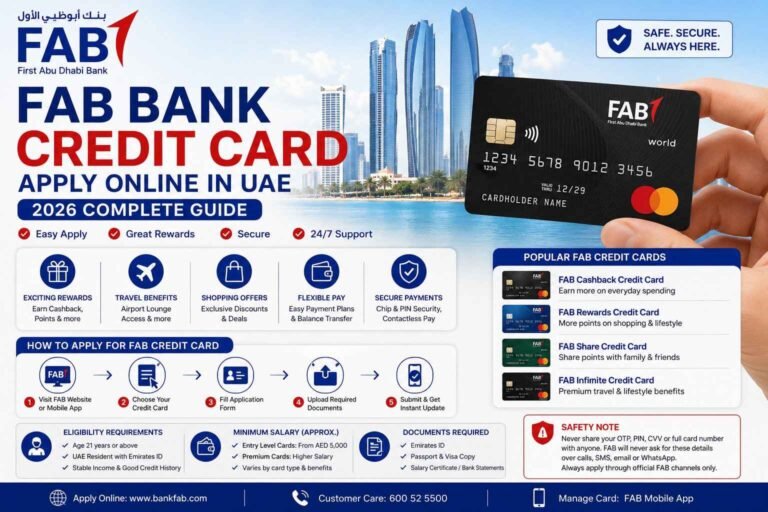
FAB Commercial Credit Cards
FAB offers commercial cards aimed at different business profiles.
Its current commercial-card range includes premium options such as the ONYX Commercial Credit Card and other business-card products.
The cost difference can be significant, though.
FAB’s published commercial banking fees currently list an annual membership fee of AED 2,500 for the ONYX Commercial Credit Card and AED 400 for its Silver Commercial Credit Card. FAB also lists a 3.99% monthly interest rate on retail purchases for both products.
That means a premium business card should make financial sense for the company using it.
If your business does not actually use airport lounges, travel benefits, concierge services or other premium features, paying more for them may not be worthwhile.
The card with the highest cashback may still be the wrong card
Imagine a UAE company spends AED 30,000 every month.
AED 12,000 goes to suppliers.
AED 7,000 goes toward salaries and operational expenses.
AED 5,000 goes toward fuel.
AED 4,000 is spent internationally.
AED 2,000 goes toward other purchases.
A card offering a high reward on fuel could look attractive.
But if another card provides better value on international transactions and has lower foreign-exchange costs, the second card could produce more real value over the year.
This is why your spending mix matters more than the advertised maximum reward.
Check the annual fee before looking at rewards
A rewards card only makes sense if the rewards you actually earn outweigh the cost of holding it.
This sounds obvious, but it is easy to overlook when a card advertises cashback, travel privileges or welcome bonuses.
FAB’s published commercial-card fees demonstrate how different annual charges can be between business products.
The same principle applies elsewhere.
Do the calculation using your company’s realistic annual spending rather than the maximum advertised reward.
If a card costs AED 800 a year but your realistic rewards are only AED 400, the rewards are not really saving the business money.
Don’t ignore foreign transaction fees
This is one of the most important checks for UAE businesses dealing with overseas suppliers.
A card can have attractive cashback and still become expensive when used internationally.
For example, FAB currently lists an international transaction fee of 2.61% of the transaction value plus applicable scheme charges for its listed commercial credit cards.
CBD lists a 2% foreign-exchange fee on its business credit card.
If your company regularly spends tens of thousands of dirhams outside the UAE, this fee deserves attention.
A small percentage becomes a real cost at higher transaction volumes.
Business credit card vs corporate card
These terms are sometimes used interchangeably, but they are not always solving the same problem.
A straightforward business credit card can be useful for a small company where the owner controls most spending.
A corporate card becomes more interesting when multiple employees need access.
ADCB, for example, currently offers corporate products covering general corporate spending, purchasing, employee spending and virtual cards.
If your problem is not “how can I earn more rewards?” but rather “how can I stop losing track of employee expenses?”, a corporate spending-management solution may be more useful than a traditional rewards card.
What banks may look at before approving a business card
Getting a business credit card is not simply a matter of choosing a product and submitting a form.
The bank may assess the company, its owners, financial profile, existing relationship and repayment ability.
Requirements vary between banks and products.
For example, CBD currently states that its Business Credit Card is available to owners and nominated staff of registered business entities in trading, manufacturing, professional and service sectors, and lists a minimum average business-account balance of AED 25,000 as part of its criteria.
The Central Bank of the UAE also has rules governing credit-card issuance and related requirements.
So don’t assume that qualifying for one UAE business card means you will automatically qualify for another.
What documents might you need?
The exact list depends on the bank and the business structure.
Expect the application to involve company information and personal identification for the people authorised to use or manage the card.
Banks may also request financial or banking information as part of their assessment.
It is better to prepare the company’s basic documents before applying rather than starting several applications without knowing the eligibility criteria.
Multiple applications can also be unnecessary if the business clearly does not meet the bank’s requirements.
What about a new UAE business?
This is where many comparisons become unrealistic.
A newly established company may not have the same financial history as an established SME.
Some business cards are designed around an existing banking relationship, business balances, turnover or credit assessment.
If your company is new, don’t choose a card simply because another business owner recommends it.
Check whether the bank’s eligibility criteria actually fit your company’s age, banking relationship and financial profile.
Don’t carry a balance just to earn rewards
This is probably the most important calculation in the entire comparison.
Rewards only make sense when the business can manage the repayment cost.
Emirates NBD’s current Key Facts Statement, for example, lists annual percentage rates for its Business Rewards and Business Card products and specifies minimum-payment rules.
If a company earns a small cashback amount but regularly carries an expensive outstanding balance, the interest can easily outweigh the rewards.
A business credit card should help manage spending and cash flow, not become an expensive substitute for working capital.
So, which business credit card is best?
For broad category rewards, Emirates NBD’s Business Credit Card is worth considering because its current rewards structure covers international spending, hotels, government services, utilities, petrol and everyday categories.
For a fuel-heavy business, CBD’s Business Visa Signature can be particularly relevant because of its published ENOC and EPPCO rewards.
For a business looking for a no-annual-fee rewards option, RAKBANK Titanium Business Credit Card deserves a look, subject to its eligibility and reward exclusions.
For a company wanting premium business and travel benefits, FAB’s commercial-card range is worth comparing, but the annual fee needs to be justified by actual usage.
For companies focused on employee spending control and corporate expense management, products such as ADCB’s corporate card range may make more sense than a conventional rewards card.
The smarter way to choose
Don’t start with the question, “Which card has the highest cashback?”
Start with:
What does my business spend money on every month?
Then compare the cards against those expenses.
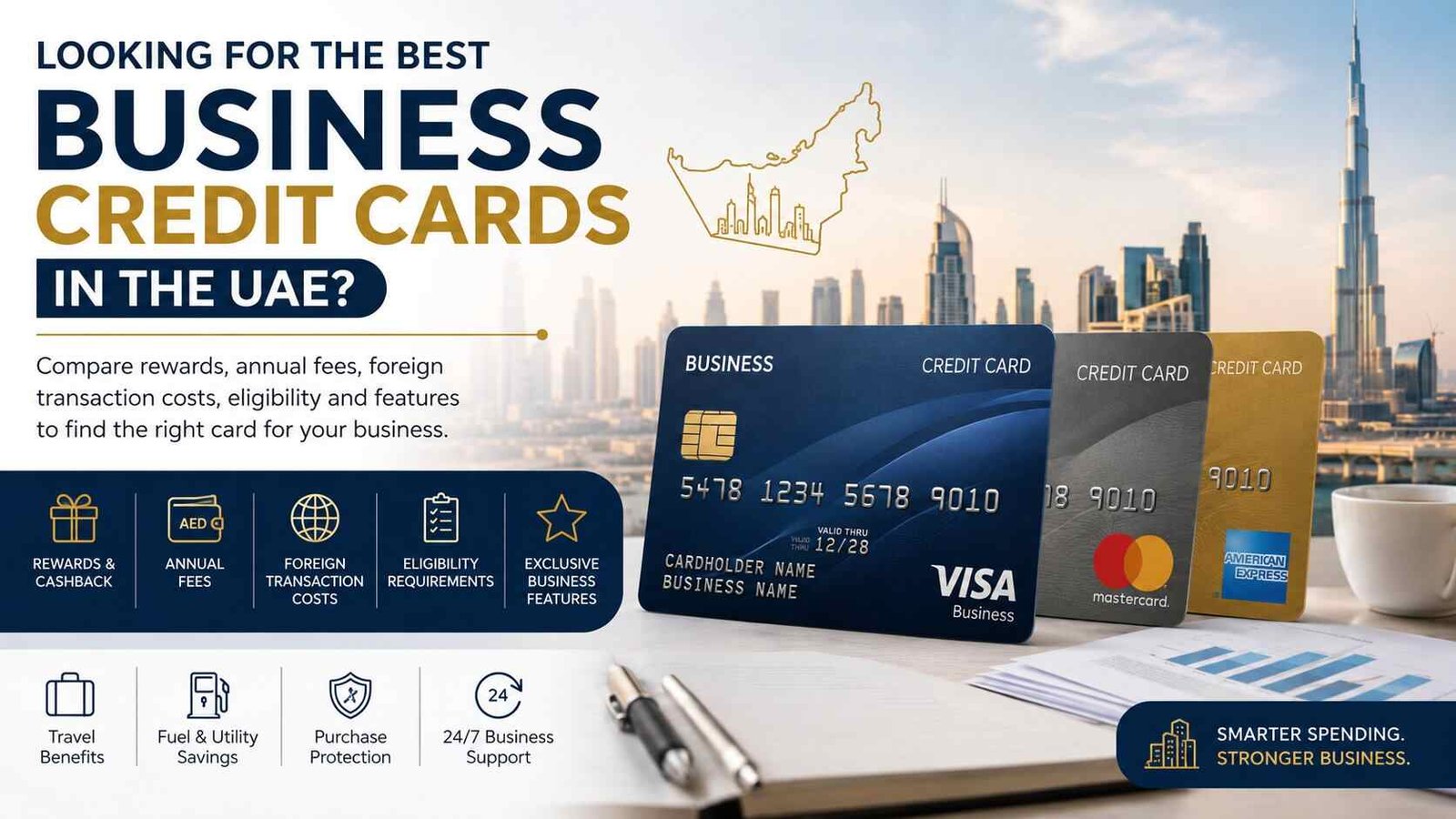
Look at the annual fee, reward caps, foreign transaction charges, interest rate, minimum payment, eligibility requirements and employee-card features.
That gives you a much more realistic answer than a generic “top five business credit cards” list.
For a UAE business, the best business credit card is the one that fits the company’s actual spending and repayment habits. A card that looks average on paper can outperform a premium card if its rewards and fees match the way your business really operates.
Frequently Asked Questions
Can a small business get a credit card in the UAE?
Yes, but approval depends on the bank and product. The bank may consider the company’s structure, financial profile, banking relationship, business balance, creditworthiness and other eligibility criteria.
Is a business credit card better than using a personal credit card?
For genuine business spending, a dedicated business or corporate card can make expense tracking and employee spending easier and can keep business transactions separate from personal purchases.
Which is better: cashback or travel rewards?
It depends on your spending. A company that spends heavily on fuel or everyday operating expenses may benefit more from cashback or category rewards, while a business with frequent international travel may place greater value on travel benefits.
Are business credit cards interest-free?
Not necessarily. Some cards may provide an interest-free period when the balance is paid according to the card terms, but outstanding balances can attract interest and other charges. Always check the bank’s Key Facts Statement and fee schedule.
What should I compare before applying?
Compare the annual fee, actual reward rate, reward caps, foreign transaction fee, interest rate, minimum payment, eligibility requirements and any employee-card or expense-management features.
The advertised cashback percentage should be only one part of the decision.