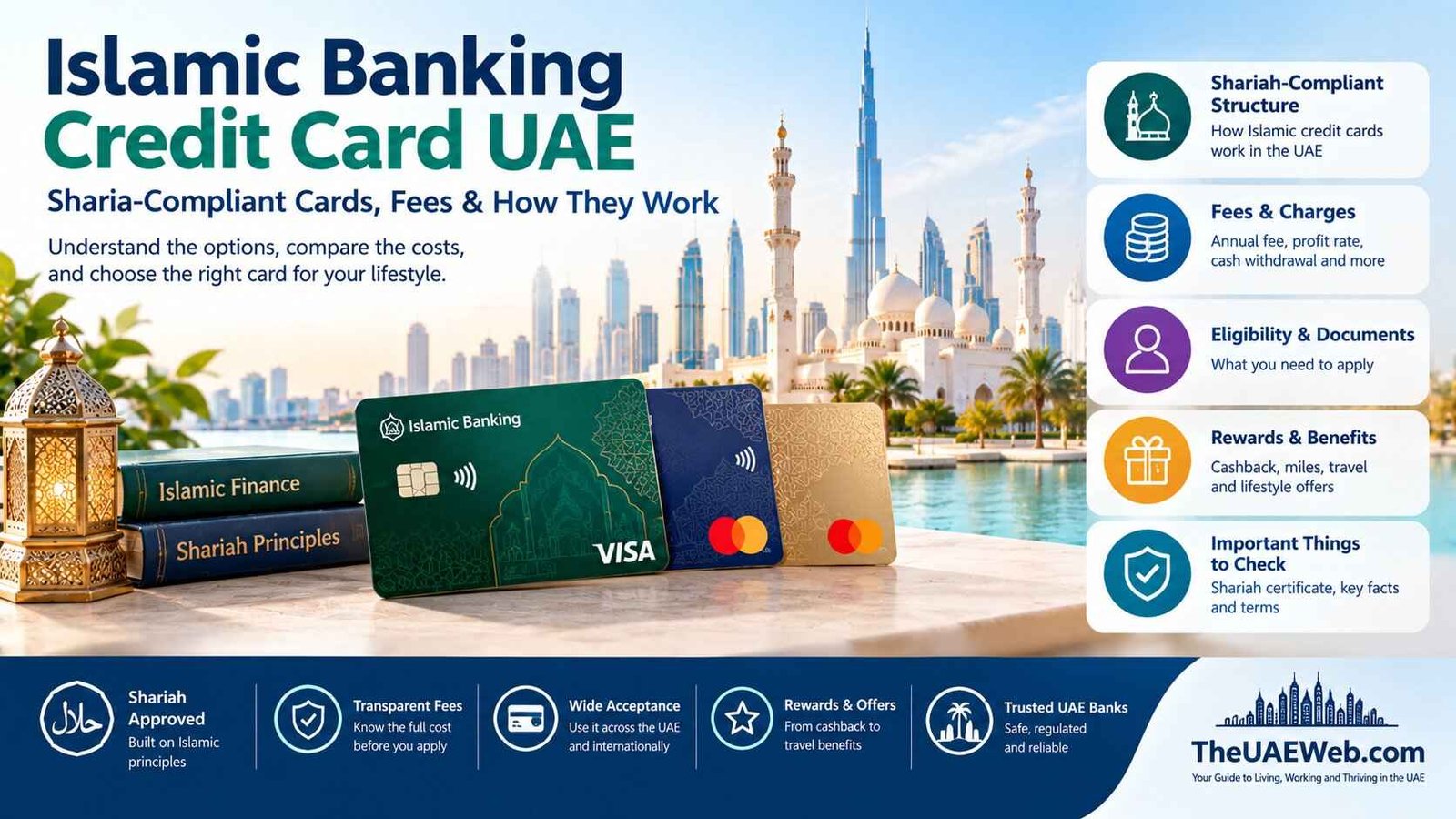
Islamic Banking Credit Card in UAE: Sharia-Compliant Cards, Fees & How They Work
If you are searching for an Islamic banking credit card in the UAE, the important question is not simply which card has the best cashback or rewards. You first need to understand how the card is structured, how the bank charges profit or fees, what Shariah approval means, and what happens if you do not pay the full amount on time.
Islamic banks in the UAE offer credit-equivalent cards designed around Islamic finance principles. Depending on the bank and card, the structure can involve contracts such as Murabaha or Ijarah, rather than a conventional interest-based credit arrangement. The exact mechanism and charges differ between products, so the bank’s Key Facts Statement and terms should always be checked before applying.
Safety note: A Sharia-compliant credit card is still a financial product with fees, payment obligations and eligibility requirements. Before applying, check the bank’s official website, Key Facts Statement, Schedule of Charges and Shariah certificate. Never share your card PIN, OTP, CVV, password or full card number with anyone claiming to arrange an application.
What Is an Islamic Banking Credit Card?
An Islamic banking credit card is a card offered under an Islamic finance structure designed to comply with applicable Shariah principles.
You can still use the card for everyday purchases, online shopping, travel, restaurants and other eligible transactions. From the customer’s point of view, many Islamic cards work much like conventional Visa or Mastercard products.
The major difference is the underlying financial structure.
For example, ADIB describes its Covered Cards as credit-equivalent cards structured according to Islamic finance principles. Its products can use structures such as Murabaha, while the bank’s Internal Shariah Supervisory Committee reviews the product.
Emirates Islamic states that its credit cards are based on a Shariah-compliant Murabaha structure.
Al Hilal Bank’s published Key Facts Statement also explains a commodity Murabaha structure for its credit cards, including a cost-plus-profit arrangement and Shariah approval through its Internal Shariah Supervision Committee.
Islamic Credit Card vs Conventional Credit Card
The easiest way to understand the difference is to look beyond the plastic card itself.
| Feature | Islamic credit-equivalent card | Conventional credit card |
|---|---|---|
| Basic purpose | Purchases and payment facility | Purchases and payment facility |
| Financial structure | Shariah-based contract | Conventional credit arrangement |
| Interest/Riba | Structured to avoid Riba under the applicable Islamic structure | Interest may apply according to the agreement |
| Profit | May be charged according to the product structure | Interest/finance charges may apply |
| Shariah governance | Islamic financial institutions operate under Shariah governance requirements | Not based on Islamic finance principles |
| Rewards | Cashback, miles, points and offers may be available | Cashback, miles, points and offers may be available |
| Visa/Mastercard acceptance | Depends on card network | Depends on card network |
The Central Bank of the UAE requires institutions offering Islamic financial products and services to comply with Shariah governance requirements. Its rules also establish responsibilities for Internal Shariah Supervisory Committees.
So, Islamic does not mean there are no costs. It means the product is structured differently and must comply with the applicable Shariah framework.
How Does an Islamic Credit Card Work?
This is where many people get confused.
You may see words such as:
- Covered Card
- Murabaha
- Ijarah
- Profit
- Shariah-compliant
- Monthly profit rate
- Annual membership fee
These terms describe different parts of the product.
Murabaha Structure
Murabaha is a sale-based Islamic finance structure where the transaction involves a known cost and profit.
For example, Al Hilal Bank’s published credit-card documentation describes its cards as operating under a commodity Murabaha structure on a cost-plus-profit basis.
The exact implementation can differ between banks, so you should not assume that every Islamic credit card works in exactly the same way.
Covered Card
Some UAE Islamic banks use the term Covered Card rather than simply calling the product a credit card.
ADIB, for example, describes its cards as credit-equivalent Covered Cards structured under Islamic finance principles.
The important thing is not the name on the card. Check the actual contract, Key Facts Statement and Shariah documentation.
Do Islamic Credit Cards Charge Interest?
This is one of the most searched questions.
A Shariah-compliant Islamic credit card is designed around a structure that does not use conventional Riba-based interest.
However, you should not interpret this as meaning the card is free.
Islamic cards can have:
- Monthly profit rates
- Annual membership fees
- Cash withdrawal fees
- Processing fees
- Foreign transaction charges
- Late-payment-related charges
- Replacement fees
- Other service charges
For example, Emirates Islamic currently publishes monthly profit rates and annual membership fees for various cards in its Schedule of Charges.
ADIB also publishes product-specific fees and monthly profit rates for its Covered Cards.
This is why comparing only the words “interest-free” or “Islamic” is not enough.
Look at the total cost of using the card.
Are Islamic Credit Cards Really Sharia-Compliant?
The answer depends on the specific product and its approved structure.
In the UAE, Islamic financial institutions operate within the Central Bank’s Shariah governance framework. The Central Bank states that Islamic financial institutions must integrate Shariah compliance into their processes and operations, while Internal Shariah Supervisory Committees have responsibilities relating to Shariah compliance and fairness of financial products and services.
Individual banks also publish Shariah certificates and information about their card structures.
For example, ADIB states that its Covered Cards are reviewed and approved by its Internal Shariah Supervisory Committee.
Al Hilal Bank likewise states that its credit-card product is approved by its Internal Shariah Supervision Committee and that customers can view the relevant Shariah certificate.
If Shariah compliance is important to you, check the certificate for the exact card, rather than assuming every card from a particular bank has identical terms.
Islamic Credit Card Banks in the UAE
The Central Bank of the UAE currently lists several fully Islamic banks, including:
- Abu Dhabi Islamic Bank
- Al Hilal Bank
- Dubai Islamic Bank
- Emirates Islamic Bank
- Ruya Community Islamic Bank
- Ajman Bank
- Sharjah Islamic Bank
The Central Bank also lists conventional banks that operate Islamic windows.
That means you are not limited to one Islamic banking provider when looking for a Sharia-compliant card.
Examples of Islamic Credit Cards in the UAE
Several UAE banks currently offer cards marketed or structured as Sharia-compliant.
ADIB Covered Cards
ADIB offers a range of Covered Cards, including cashback, travel, rewards and co-branded products.
For example, the ADIB Smiles Visa Classic Card is described as a Sharia-compliant Covered Card. ADIB currently lists a minimum salary of AED 5,000 for that particular card, subject to its requirements.
ADIB also offers premium products such as Emirates Skywards Covered Cards. Its published information states that the cards use Islamic finance principles and are certified through its Internal Shariah Supervisory Committee.
Emirates Islamic Credit Cards
Emirates Islamic offers a broad selection of cards covering cashback, travel, Emirates Skywards, Etihad Guest and other rewards.
Its published Key Facts Statement states that its credit cards are based on a Shariah-compliant Murabaha structure.
The bank’s current Schedule of Charges also shows that different cards can have different monthly profit rates and annual membership fees.
Al Hilal Bank Credit Cards
Al Hilal Bank also offers credit cards with Shariah-compliant structures.
Its published documentation explains that its credit cards use a commodity Murabaha structure and that the product has Shariah approval through its internal Shariah supervision process.
What Salary Do You Need?
There is no single salary requirement for every Islamic credit card in the UAE.
The requirement depends on:
- Bank
- Card type
- Applicant’s income
- Employer
- Credit history
- Existing financial commitments
- Requested card limit
- Bank’s internal approval criteria
For example, ADIB currently lists AED 5,000 as the minimum salary for its Smiles Visa Classic Card.
Other premium cards can require substantially higher income.
So don’t search for one universal “Islamic credit card minimum salary UAE” figure. Check the requirement for the specific card.
Documents Usually Required
Depending on the bank and your employment status, you may be asked for:
- Emirates ID
- Passport
- UAE residence visa, where applicable
- Salary certificate
- Recent bank statements
- Proof of income
- Employment information
ADIB, for example, lists passport, Emirates ID, recent bank statements and a salary certificate among the required documents for certain Covered Cards.
Self-employed applicants may have additional documentation requirements.
Islamic Credit Card Fees You Should Check
Before applying, don’t stop at the annual fee.
Look at the complete Schedule of Charges.
| Charge | Why it matters |
|---|---|
| Annual membership fee | Can significantly affect the real cost of the card |
| Monthly profit rate | Important if you carry an outstanding balance |
| Cash withdrawal fee | Cash advances can be expensive |
| Foreign transaction fee | Important for overseas spending |
| Currency conversion charge | Can increase the cost of foreign purchases |
| Late-payment related charges | Check the exact terms |
| Card replacement fee | Relevant if the card is lost or damaged |
| Supplementary card fee | Important for family cards |
| Instalment processing fee | Check before converting purchases into instalments |
For example, Emirates Islamic currently publishes separate monthly profit rates and annual fees across its card range, showing why the cost can vary considerably from one card to another.
What Happens If You Only Pay the Minimum?
This is one of the most important things to understand before taking an Islamic credit card.
An Islamic card can still become expensive if you repeatedly carry an outstanding balance.
Your bank may calculate the applicable profit according to the card’s Islamic structure and terms.
For example, Emirates Islamic’s current Key Facts Statement says the minimum payment due is generally 5% of the closing outstanding balance or AED 100, whichever is higher, subject to the stated conditions.
The practical lesson is simple:
Do not choose a card based only on its rewards. Understand what happens when you do not clear the balance.
Can You Use an Islamic Credit Card for Online Shopping?
Yes.
An Islamic credit card can generally be used for online purchases wherever the relevant Visa or Mastercard network is accepted, subject to the bank’s terms and merchant restrictions.
ADIB, for example, states that its Covered Cards provide online and in-store purchasing functionality similar to conventional cards.
However, Islamic banks can have restrictions around transactions involving activities or products that are not permissible under their policies.
Always check the card’s terms if you are unsure about a particular merchant or transaction.
Can You Use It Abroad?
Many Islamic credit cards can be used internationally.
For example, Emirates Islamic states that its cards provide international acceptance, while its current fee information separately identifies foreign-currency-related charges.
Before travelling, check:
- Foreign transaction fee
- Currency conversion method
- Cash withdrawal fee
- ATM charges
- Travel insurance, if included
- Airport lounge conditions
- Minimum spending requirements for benefits
A card with excellent UAE rewards may not necessarily be the cheapest card for overseas spending.
Islamic Credit Card Rewards: Cashback, Miles or Points?
Sharia-compliant cards can offer many of the same practical benefits people look for in conventional cards.
These can include:
- Cashback
- Airline miles
- Hotel benefits
- Shopping rewards
- Dining offers
- Airport lounge access
- Travel privileges
- Instalment plans
For example, ADIB currently offers Covered Cards linked to programmes such as Smiles and Emirates Skywards.
Emirates Islamic also offers cashback, Skywards, Etihad Guest and other rewards-oriented cards.
But always check the conditions behind the reward.
A card offering 5% or 6% in a particular category may have spending caps, eligible-merchant restrictions or other conditions.
What Is the Difference Between Profit Rate and Annual Fee?
These are two different costs.
The annual fee is a membership or card fee charged according to the product terms.
The profit rate relates to the financing structure of the card.
For example, Emirates Islamic’s current card schedule lists both monthly profit rates and annual membership fees for different cards.
This means a card with no annual fee is not automatically free to use.
You should look at the complete cost structure.
How to Choose an Islamic Credit Card in the UAE
Instead of asking which card is “best,” start with your actual spending pattern.
If you pay the full balance every month
Focus more on:
- Annual fee
- Cashback or rewards
- Spending categories
- Welcome offers
- Foreign transaction fees
- Benefits you will actually use
If you travel frequently
Look at:
- Airline miles
- Airport lounge access
- Travel insurance
- Foreign transaction charges
- Airline-specific benefits
If you mainly spend on groceries and fuel
A cashback card may make more sense than a premium travel card if the cashback categories match your spending.
If you sometimes carry a balance
Pay much closer attention to the applicable profit rate, minimum payment rules and total cost.
This is where a flashy rewards offer can become less important than the underlying financing cost.
Questions to Ask the Bank Before Applying
Before submitting an application, ask the bank these questions:
1. What is the exact Shariah structure of this card?
Do not rely only on the word “Islamic.”
2. Is there a Shariah certificate for this specific card?
Ask where you can view it.
3. What is the monthly profit rate?
Get the current figure in writing.
4. What is the annual membership fee?
Also ask whether it can be waived and what spending conditions apply.
5. What happens if I pay only the minimum amount?
This can materially affect the cost.
6. What is the cash withdrawal fee?
Cash transactions can have different charges from purchases.
7. What are the foreign transaction charges?
This matters if you shop or travel outside the UAE.
8. Are there spending limits on cashback or rewards?
A headline reward percentage does not necessarily apply to unlimited spending.
A Simple Way to Compare Islamic Credit Cards
Don’t compare cards using only the reward percentage.
Create a small comparison like this:
| What to compare | Card A | Card B | Card C |
|---|---|---|---|
| Minimum salary | |||
| Annual fee | |||
| Monthly profit rate | |||
| Cashback/rewards | |||
| Foreign transaction fee | |||
| Cash withdrawal fee | |||
| Supplementary card fee | |||
| Shariah certificate | |||
| Minimum payment | |||
| Key exclusions |
This takes a few minutes and can reveal differences that are easy to miss on a promotional page.
Islamic Banking Credit Card UAE: What You Should Remember
An Islamic banking credit card is not simply a conventional credit card with the word “Islamic” added to it.
The underlying structure, Shariah governance, profit calculation, fees and contractual terms matter.
The UAE has a regulated Islamic banking sector, with fully Islamic banks as well as conventional banks operating Islamic windows.
ADIB, Emirates Islamic and Al Hilal Bank are examples of institutions currently publishing Shariah-compliant credit-card products and related documentation.
If you are choosing a card, start with the Key Facts Statement and Schedule of Charges, then look at rewards. That order can save you from choosing a card because of a headline offer while overlooking the actual cost of using it.
For UAE residents comparing banking products, TheUAEWeb.com focuses on practical explanations that help you understand the important details before applying.
FAQs
What is an Islamic banking credit card?
It is a credit-equivalent card structured according to Islamic finance principles and subject to the applicable Shariah governance framework. Different banks can use different structures and terminology.
Is an Islamic credit card interest-free?
Islamic credit cards are structured to avoid conventional Riba-based interest, but they can still involve profit rates, annual fees and other charges. Always check the specific card’s Key Facts Statement.
Which UAE banks offer Islamic credit cards?
The UAE has several fully Islamic banks, including ADIB, Al Hilal Bank, Dubai Islamic Bank, Emirates Islamic, Ajman Bank and Sharjah Islamic Bank. The Central Bank also lists conventional banks with Islamic windows.
Can I get an Islamic credit card with a salary of AED 5,000?
Some cards have minimum salaries around this level. For example, ADIB currently lists AED 5,000 for its Smiles Visa Classic Card, subject to its approval requirements. Other cards can require higher salaries.
Are Islamic credit cards accepted internationally?
Many are, depending on their Visa or Mastercard network and the bank’s terms. Check foreign transaction and currency-conversion charges before travelling.
Should I choose cashback or travel rewards?
That depends on how you actually spend. Compare the annual fee, reward conditions, spending caps and other charges rather than choosing based only on the advertised reward percentage.
Where can I check whether an Islamic credit card is Sharia-compliant?
Check the bank’s official product page, Key Facts Statement and published Shariah certificate. The exact documentation for the specific card is more useful than relying on a general description of Islamic banking.